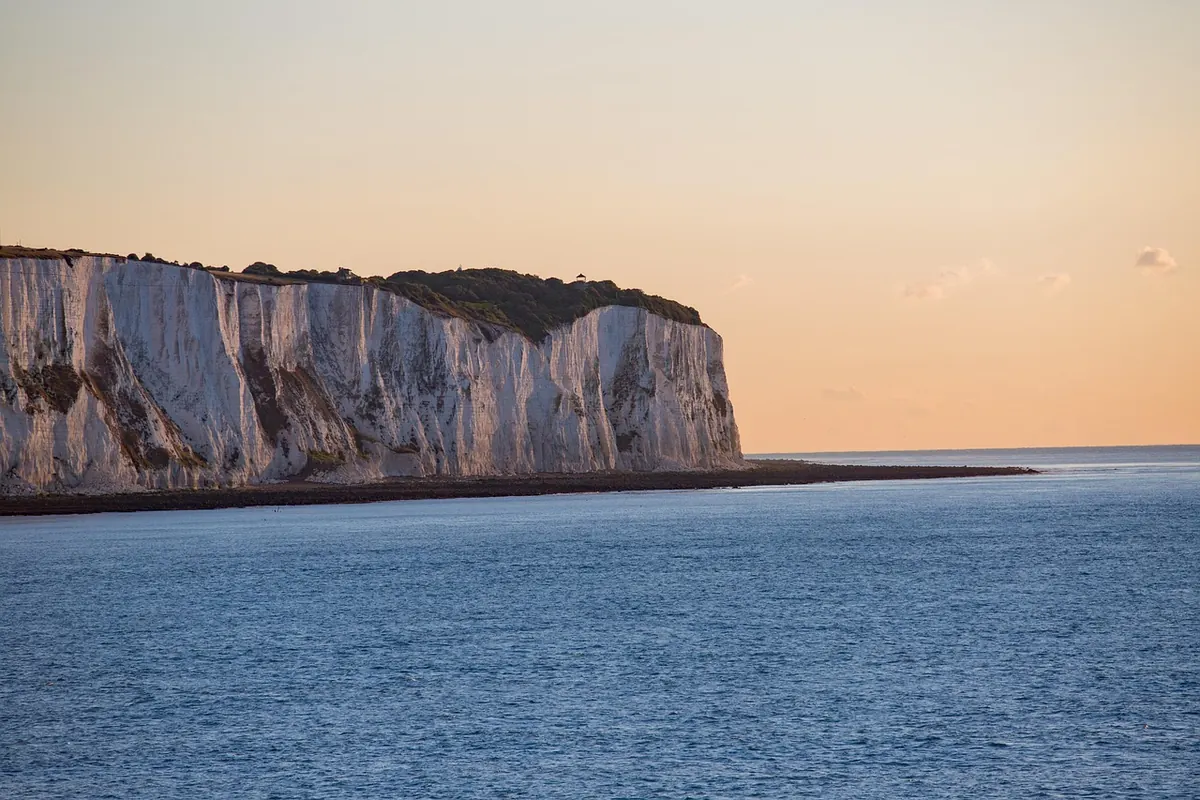
Chalk and limestone share a family resemblance that catches out plenty of people. Both are pale, both are made mostly of calcium carbonate, both fizz when you drip dilute acid on them, and both give rise to thin, alkaline soils with a taste for wildflowers. Stand at the foot of a cliff or on a hilltop, though, and the differences begin to show — in the shape of the slope under your boots, in the way the rock breaks, and in where the rain goes when it hits the ground.
What follows is a field comparison: what to look at, in what order, and what each answer tells you.
Chalk is a very pure, very soft limestone. It formed during the Cretaceous period from the calcite plates of microscopic plankton settling in calm water. Those plates — coccoliths — are still there, which is why a lump of chalk smears to a white paste under your thumbnail. The chalk of the South Downs, the Chilterns, the Yorkshire Wolds and the cliffs of Kent and Sussex runs to hundreds of metres thick, and it is porous: water sits inside the rock itself, in the tiny gaps between grains.
Carboniferous limestone is older, harder, and formed in warm shallow seas where shells, corals and crinoids piled up and were cemented together. It is grey rather than white, crystalline rather than powdery, and largely impermeable. Water cannot get inside it; it has to travel along joints and bedding planes. That single difference explains much of what you see on the surface.
The age gap matters too. Chalk is Cretaceous, laid down roughly 100 to 66 million years ago, while most of the limestone in Britain is Carboniferous, around 359 to 299 million years old. That extra time has allowed limestone to be folded, faulted and mineralised, so it often feels tougher and more varied than chalk. Chalk, by contrast, is still a relatively simple, uniform rock — which is exactly why it erodes into such recognisable landscapes.
Chalk sea cliffs are the ones on the postcards: near-vertical, brilliantly white, occasionally streaked with dark bands of flint. The Seven Sisters, Dover and Flamborough Head are all chalk, and all are retreating. Chalk is soft, it loses its grip quickly, and it falls in chunks rather than in a slow, tidy way. Stand well back, and treat flint bands as a signature.
Carboniferous limestone cliffs look quite different. They are grey and built in steps. Bedding planes — the original horizontal layers — and vertical joints cut the rock into blocks, so the face is a staircase of ledges rather than a sheer white plane. Run your hand over it and you will feel hard, cold, slightly crystalline rock that rings when tapped.
One caveat: not every white cliff is chalk. Some limestones and even some sandstones can look pale in strong sunlight. Look instead for the combination of softness, flint bands and a powdery white streak. If the rock is hard, grey and blocky, you are almost certainly on limestone.
Chalk makes smooth country. Its downs are rounded and rolling, with long, even ridges and shallow dry valleys cut during cold phases when the ground was frozen and could not absorb meltwater. Those dry valleys, and their steeper amphitheatre-shaped cousins — coombes — are a chalk speciality, as is the classic escarpment profile: a steep scarp slope facing one way, a long gentle dip slope the other.
Limestone country is more abrupt. Plateaus are often bare, with limestone pavement split into clints and grykes — blocks of rock separated by widened joints, with plants sheltering in the shaded cracks. Gorges cut steeply through the plateau, potholes drop into the dark, and cave systems run for kilometres underground. Cheddar Gorge, the White Peak and the limestone country of the Yorkshire Dales all show that fractured, blocky character.
On chalk, rain soaks straight into the rock. There is little surface drainage, and streams are fed by springs along the base of the escarpment. Chalk streams run clear, cool and steady because the aquifer buffers them, and winterbournes flow in the wet months and vanish in summer. The Test and the Itchen are chalk rivers; their constant flows are only possible because of the rock underneath.
Limestone behaves differently. Water goes down joints, swallow holes and sinkholes, travels through cave systems, and reappears at large springs known as resurgences. Streams that lose themselves a metre into their own bed are a limestone sight. Find a gorge with no river in the bottom of it and you are almost certainly on limestone. Malham Cove in the Yorkshire Dales is a classic example: a dry limestone cliff with a resurgence rising at its foot, rather than a river pouring over the top.
Chalk soils are thin, dark, crumbly and alkaline — rendzinas, to use the soil name. They drain quickly and dry out in summer, which keeps them low in nutrients and rich in flowers. Chalk grassland carries sheep's fescue, salad burnet, thyme, wild marjoram and orchids, while beech often crowds the steeper scarp slopes of southern England.
Limestone soils are alkaline too, so the plant lists overlap. The mosaic is usually finer, though. Bare pavement holds mosses and stonecrop in the grykes; damp shaded cracks may shelter hart's-tongue fern, while the surrounding grassland can be a tight, flower-rich turf of blue moor-grass, rockrose and bloody crane's-bill. Ash, hazel and yew are typical limestone woods, often growing straight out of shattered rock.
When you are standing in front of an outcrop and cannot decide, work through this sequence.
No single test is foolproof, but together they usually settle it. The landscape is the sum of the rock, and the rock is rarely shy about showing what it is made of.
Chalk often contains flint — black or grey nodules and bands of silica that formed within the sediment. Flint is hard, glassy when broken, and leaves a sharp edge. Carboniferous limestone more often contains visible fossils: crinoid stems like small stacked coins, brachiopod shells, coral cups and the occasional fish tooth. Chert can occur in limestone too, but it is usually darker, duller and less regular than chalk flint.
Use the acid test as a confirmation rather than a starting point. A drop of dilute hydrochloric acid on chalk produces an immediate, vigorous fizz and a soft white residue. On limestone the reaction is still clear but less dramatic, and the undissolved impurities may leave a grey or brownish mark. Combined with what your eyes and boots are telling you, that small bottle of acid can turn a guess into a confident identification.
If it powders in your hand and the cliff is white, think chalk. If it rings under your boot and the hillside is a maze of walls and grykes, think limestone.
Photo: JStolp / Pixabay